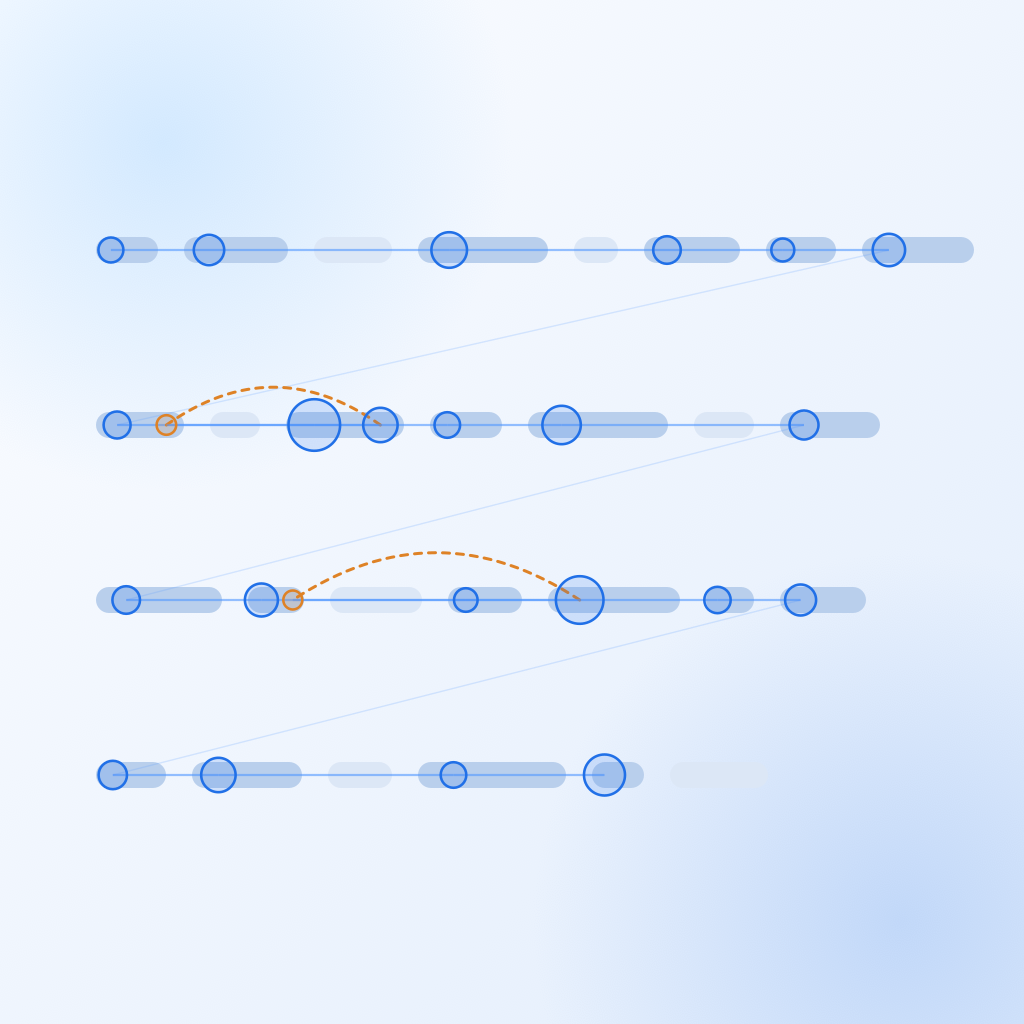
TL;DR: A study led by Aalto University and published in Nature Human Behaviour in August 2026 modelled how people read without using a single eye-tracking recording: the model was given only an objective (comprehension) and a budget (limited time, memory and vision), and word-skipping and backtracking emerged on their own. The implication for business simulations is direct — measuring the outcome of a decision is not enough; the process leading to it has to be modelled too.
The measurement logic of business simulations has so far been outcome-driven: market share, profitability, cash position, shelf efficiency, the number of critical emails missed. These measures produce a ranking, and a ranking starts a productive discussion. Yet the same outcome can be reached by entirely different decision paths, and the scoreboard cannot tell those paths apart. A recent approach in decision science offers a concrete method for closing that gap.
The Difference Between a Model That Imitates and One That Explains
Researchers from Aalto University, led by Antti Oulasvirta, together with colleagues from the Hong Kong University of Science and Technology, City University of Hong Kong and the National University of Singapore, produced a model that explains eye movements during reading. The study was published on 10 August 2026 in Nature Human Behaviour and drew wide attention within days.
What distinguishes the model is its method rather than its result. Earlier approaches paired text fragments with eye-tracking data and learned to imitate human behaviour. The imitation was convincing, but those models did not understand what they read and lost reliability when moved to new languages or new contexts. The new model was trained on no eye-tracking data at all. The researchers defined an objective and a resource budget for it: understand the text as well as possible, but account for having limited time, limited memory and a limited field of vision. Learning to strike that balance across millions of texts, the model began — without being taught to — skipping predictable words, lingering on difficult passages and going back when meaning broke down.
For the first time we've used AI methods to understand — not just mimic — how people read.
Antti Oulasvirta, Aalto University
The validation stage makes the distinction clearer still. Thirty-nine adult participants reading under time pressure changed their strategies: when time was short they moved to scanning the whole text, and when time allowed they concentrated on the difficult sections. When the same constraint was altered in the model, the model shifted in the same direction. The reason is that the behaviour was not hand-written into the model but derived from the constraints.
Resource Rationality: Deriving Behaviour From a Budget
The principle the study rests on is resource rationality. It holds that human behaviour is not optimal in absolute terms, but is strikingly optimal once the available resources are taken as given. To predict how someone will behave, it is enough to know what they are trying to achieve and what budget they are working with; the behaviour itself can be derived from those two.
For modelling, this reverses the direction of work. Behaviour is not fitted to data, it is predicted from a principle. That also makes it possible to ask what would happen in a situation never observed before.
Three Nested Timescales
The second distinguishing feature of the reading model is that it is hierarchical. Decisions are made not at one level but across three nested timescales, with the higher level allocating budget to the lower one:
- The fixation level: A single pause of roughly 250 milliseconds serves word recognition. Where the gaze lands and how long it stays is settled at this level.
- The sentence level: Integrating information determines which word gets skipped and where to return to. Skipping and regression decisions come from here.
- The text level: The purpose of reading itself — what the reader wants to learn from this text — shapes what is held in memory and which section is reread.
This architecture also holds for a participant in a business simulation. The fixation level corresponds to reading a single piece of data: which row of the report was consulted, which chart was opened and closed. The sentence level corresponds to a tactical move: skip this analysis and set the price, or go back to last quarter's competitor data. The text level corresponds to strategy: which uncertainty the round's budget is being spent on. The mapping is structural, not literal — a fixation and a pricing decision are not the same cognitive event. What they share is the allocation of a limited resource across nested timescales.
What the Scoreboard Cannot See
The data stored in today's simulations is mostly the decision that was submitted. Yet two participants can make the same decision and reach the same outcome while following completely different policies. The two teams below achieve the same market-share gain in the same quarter:
- Team A: Reads the competitor report, the demand data and the cost table in sequence, dwells a long time on the cost table, returns once to the competitor data and then sets the price. The policy followed is to close the uncertainty and then decide.
- Team B: Reads only the brief, never opens the three data sources and prices on instinct. Because the demand shock breaks in its favour, it reaches the same outcome. The policy followed is to decide fast and trust to luck.
The scoreboard cannot tell these two teams apart. What the participant carries back to work, however, is not the number but the policy. When Team B plays the next quarter with the same policy the demand shock will break against it, and what it learned will turn out to be wrong — but real life, not the simulation, will be the one to teach it. This was exactly the situation in the reading research: the outcome measured was comprehension, while the part that carried the explanation was the fixations.
Why the Decision Process Is Modelled With Reinforcement Learning
The first way that comes to mind for modelling a decision process is to record a large number of decisions and train a predictive model. That route runs into two obstacles. First, there is no corpus labelled "correct managerial decision". Second, even if there were, it would encode the biases of the past and would not generalise to scenarios never seen before. This is precisely the limit the earlier reading models hit.
Reinforcement learning offers a different contract: instead of behaviour, an objective and a set of constraints are defined, and the policy follows from them. The Computational Behavior Lab at Aalto University has applied this approach repeatedly across widely separated domains:
- Multitasking while driving: Jokinen, Kujala and Oulasvirta explained how drivers divide attention between the road and the screen as optimal adaptation under uncertainty. Risky driving behaviour emerged as a rational response to noise in motor control.
- Pedestrian crossing decisions: Pedestrians' decisions about when to cross were shown to be explicable within a framework of bounded-optimal decision-making.
- Typing on a touchscreen: The CRTypist model moves its gaze and its finger like a human while typing; it makes errors, looks to the upper part of the screen to notice them and corrects them.
- Adapting interfaces: In work on adapting interfaces to users with model-based reinforcement learning, the user model was placed directly inside the optimisation loop.
The significant development is not the individual results but the maturing of the method. A step-by-step workflow for building these models is now defined in the academic literature, and the approach is positioned not as a single technique but as a general theory of interaction. This is not one laboratory's one-off success; it is a transferable method.
There Is No Such Person as the "Average Participant"
This is the most critical point for simulation design. In a resource-rational model the constraints are written down explicitly: working-memory capacity, visual acuity, reading speed, language proficiency, domain knowledge. Change those parameters and what you have is a different user.
In the relevant studies this stands out as a core capability rather than a feature added afterwards. One of CRTypist's stated benefits is being able to simulate users of differing abilities who are hard or impossible to recruit into a study. Other work predicts not an average scanpath but personalised scanpaths. Cognitive abilities have been shown to predict performance in everyday computer tasks. How menu-search strategies develop with experience has been modelled — meaning skill is not a fixed coefficient but a trajectory.
For a training platform the implication is direct: the same scenario is a different problem for different participants. A newly graduated analyst and a category manager of fifteen years do not see the same information when they look at the same inbox. If the participant can be parameterised, so can the scenario and the feedback.
What a Simulation That Models the Decision Process Looks Like
This approach has five concrete implications for business simulation design.
1. Process Telemetry Becomes First-Class Data
The path to a decision is data too: which panels were opened, in which order, how long they stayed open, which report was returned to, how long it took to reach the first decision, how many times the decision was revised. In the language of the reading model these are fixation duration, skipping and regression. They cannot be modelled unless they are recorded, and most platforms do not record them today.
2. Policy Diagnosis Instead of a Ranking
The output of a debrief session can be not "you came third" but "this is the policy you followed": deciding fast without closing the uncertainty, over-analysing and arriving late, over-trusting a single source, seeking evidence after the decision. These descriptions carry far more educational information than a ranking and connect directly to a change in behaviour.
3. Scenarios Are Tested With a Synthetic Cohort Before Reaching a Classroom
Running a cohort of simulated participants through a scenario answers questions such as: is the scenario too easy, is there a degenerate strategy that bypasses the trade-off it is meant to teach, can it distinguish the careful participant from the lucky one? Today these questions can only be answered after several pilot sessions and at considerable cost.
4. Information Load and Time Pressure Become Adaptive
Participants in the reading study changed their strategies when time pressure changed. The same levers exist in a simulation: round duration, the number of reports that can be opened, the cost of accessing information. If the participant's model is known, these levers can be tuned per person, bringing everyone close to their own learning edge rather than to a common difficulty curve.
5. Accessibility and Fairness Become Measurable
If the participant model is defined explicitly, this question can be tested: does the simulation penalise a participant who is a non-native speaker or a slower reader for a reason unrelated to business judgement? It stops being an implicit assumption and becomes a testable criterion.
The Limits of the Analogy
Defending this approach honestly requires stating where it weakens. Four limits stand out:
- The objective-function problem: In reading, "comprehension" is a goal one can agree on. In a business decision, what the objective is often turns out to be the very thing being taught. Resource rationality requires a defined objective; define it wrongly and the result is a confidently wrong model.
- Social and organisational constraints: Reading is a solitary, short-horizon activity. Strategic decision-making is social and long-horizon; the process is usually blocked by organisational rather than cognitive constraints — who has to be persuaded, who has access to the data, which discussion fits into the meeting.
- The risk of turning into surveillance: Process data is collected to diagnose the participant and adapt the scenario, is shown to the participant openly, and is not passed to their manager as a productivity score. Unless that boundary is written into the product, good intentions are not enough.
- The obligation to validate: A model is a generator of hypotheses, not an arbiter. The reading model was tested against 39 participants and decades of reading findings. Unless a decision-process model goes through the same discipline, it remains a better-looking guess.
Conclusion: The Question Changes
The question simulations have asked until now has been "what did you decide". The scoreboard measures that question well and should go on measuring it.
The question of the next generation will be "how did you arrive at that decision": which information was consulted, what was skipped, where the participant went back to, when they stopped and decided. There is a concrete reason to believe this is possible — a research team achieved it for a process as fast, as automatic and as invisible as reading a sentence, and did so without using a single eye-tracking recording.
A business decision is far more complex than reading a sentence. The structure, however, is the same: limited time, limited attention, limited memory, and a continuous, largely unnoticed series of choices about where to spend them. The real work of a simulation is to make those choices visible. SimAna's decision-focused solutions continue to be developed in that direction.
Ready to transform your training?
Experience the power of simulation-based learning with SimAna.
Request a Demo